

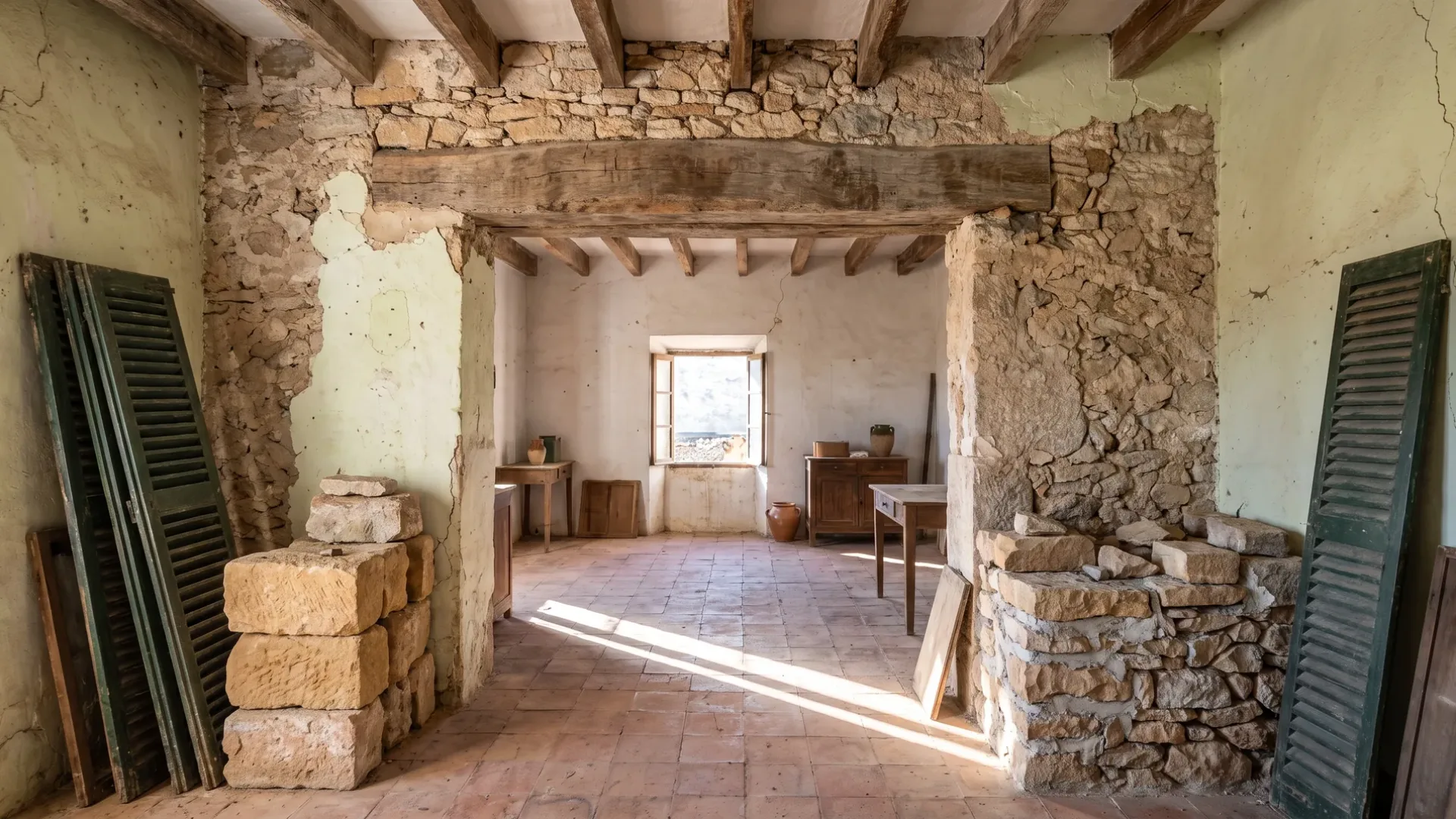
Rustic Renovation in Mallorca
Rustic is the loosest word on this list. It can mean a building whose age is still visible, or a finish deliberately made to look that way in a building that has none. Both are legitimate, they cost differently, and only one of them is reversible.
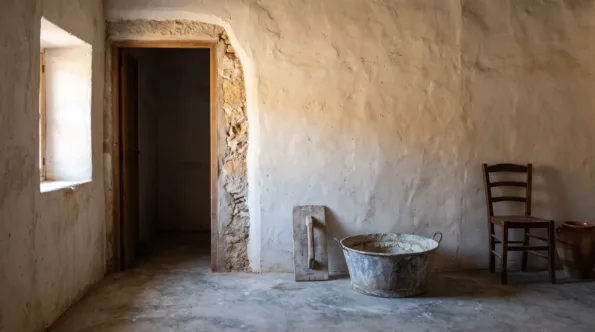
Real age and applied age are different products
Genuine age is irregular in ways that are hard to invent, because it was produced by use rather than by intention. Stone worn where hands and feet actually went. Plaster that follows a wall which was never flat. Beams that sag slightly toward the middle of the span. Nothing about it repeats, and the irregularities all have a cause.
Applied age is a finish, and a good one is real work: hand-floated plaster, lime washes built up in layers, reclaimed timber, stone laid by somebody who knows how a wall was actually coursed. Done well it is convincing and it is not cheap, because irregularity has to be produced by hand and hand time is the expensive kind.
Done badly it is unmistakable, and always for the same reason: the wear is in the wrong places. Distressing spread evenly across a surface, or heaviest where it looks best rather than where a hand would have touched, reads as decoration within about a second. That is the whole test, and it is worth applying to any sample before it goes on a wall.
What the finish is usually made of
- Hand-applied lime or clay plaster, floated rather than trowelled flat
- Limewash in layers, so the colour varies across a wall
- Exposed timber beams, original or reclaimed
- Stone left visible in some walls and rendered in others
- Terracotta and reclaimed tile floors, laid with wide joints
- Timber, wrought iron and unlacquered metal rather than chrome
- Solid doors, visible hinges and ironmongery as detail
- Deep sills, reveals and openings kept small
- Furniture in oak, olive and other local timber
- Very little gloss anywhere, because gloss reads as new
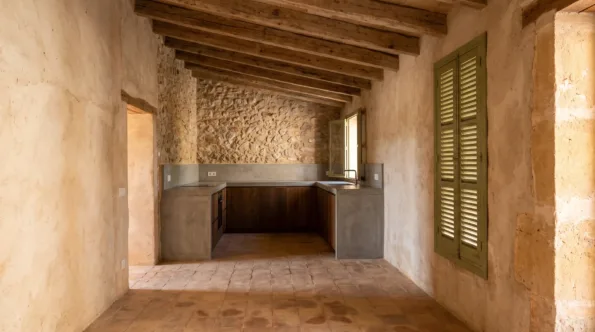
Where it fights the rest of the building
Two practical points nobody mentions until it is being built. The first is cleaning. Rough plaster, wide grout joints and open stone hold dust, and on a house that is let or used seasonally that is a real running cost rather than an aesthetic footnote. It is worth deciding which surfaces are rough and which are not, room by room, rather than applying the style everywhere.
The second is the junction with anything modern. A flush kitchen, a frameless shower or a shadow-gapped skirting needs a straight line to die into, and a hand-floated wall does not have one. Those details either get a deliberate transition, which is design work, or they get scribed on site by somebody good, which is time. Both are fine and both have to be in the price.
Rustic is also the one style where doing less is usually better. A building with three genuinely old surfaces and everything else quiet reads older than one where every surface has been given texture.
Where the work happens
General builders
How your request reaches a company
Mallorca Renovation is a comparison service. A request for a rustic renovation goes to the renovation and building companies on our list; they quote the work and carry it out, and any agreement is between you and the company you pick.
-
01
Describe the job
Tell us the property, roughly what you want and where it is. Photographs and a rough plan help, though neither is required.
-
02
We match it
The request goes to companies that work in your area and take on this kind of job at this size.
-
03
They quote you
Each company contacts you directly with its own price, timing and approach. We do not set any of it.
-
04
You compare and choose
Put the quotes side by side and take the one you want, or none of them. Using the site costs you nothing.
Can a new building be given this finish?
Yes, and it is done often. The materials and the techniques are available and the result can be very good. What it will not have is the irregularity that came from use, so the honest version leans on real materials and restraint rather than on applied wear.
Is reclaimed timber worth it over new?
For visible beams it usually is, because the grain, the marks and the colour are difficult to reproduce. It costs more, it needs checking for what is inside it, and it has to be specified early since supply is what it is. For anything hidden there is no argument for it.
How do I stop it looking like a theme?
Use fewer textured surfaces than you want to, keep the modern parts frankly modern rather than disguised, and put the roughness where somebody would actually have touched or worn the building. Restraint is the whole technique.
Is rough plaster harder to live with?
A little. It holds dust, it is harder to wipe, and it does not take a clean edge against joinery. None of that is a reason to avoid it, and all of it is a reason to choose which rooms get it.