

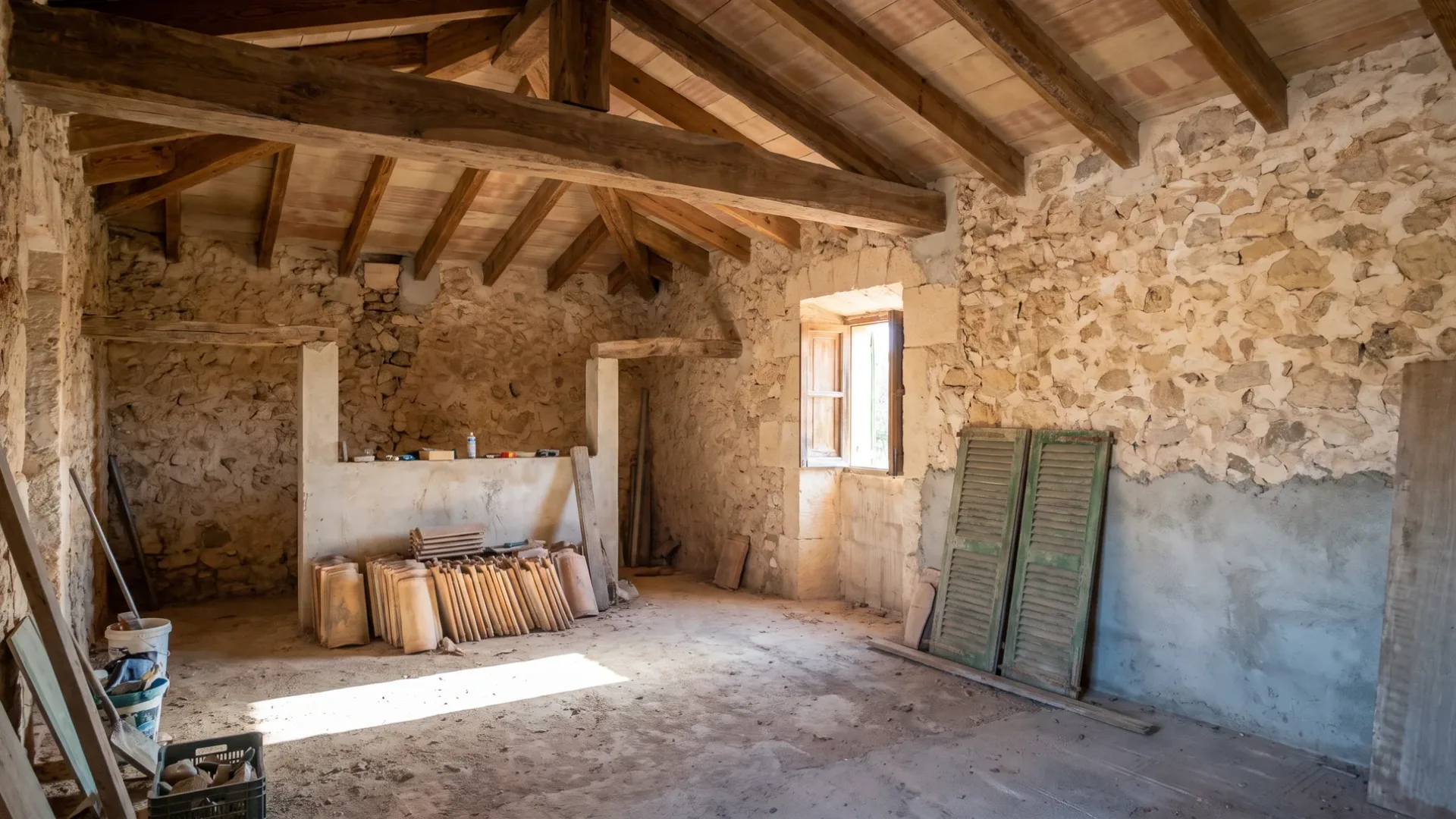
Finca Restoration in Mallorca
A finca was a working building. The thick walls, the small windows, the animal floor below and the store above were all answers to farming rather than to living, and restoring one means deciding which of those answers to keep once the farm has gone.
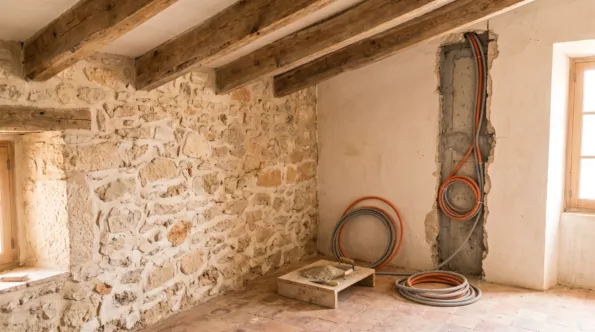
Restoration and modernisation pull in opposite directions
Restoration puts skilled time into what is already there: repointing in lime, piecing in stone, repairing beams, relaying a floor that was lifted. Modernisation puts money into what was never there at all: insulation, an electrical installation, water under pressure, drainage, cooling, and glazing that keeps heat where you want it.
Almost every finca project does both, and the trouble starts when nobody has said which parts are which. A wall can be repaired in lime and then insulated internally in a way that stops the lime working, and both decisions were reasonable on their own. The two have to be taken together or the second quietly undoes the first.
So the useful early step is not choosing a style. It is writing down, room by room and element by element, what is being kept, what is being repaired and what is being replaced. It costs an afternoon and it is the difference between a coherent building and a series of good decisions that fight.
What a finca was built with, and what it was built for
- Rubble and coursed stone walls, often a metre thick or more
- Lime mortar throughout, and no cavity anywhere
- Ground floors built for animals, with the living rooms above
- Small deep openings, placed for shelter rather than for view
- Heavy timber beams, sometimes reused from an older building
- A cistern, a well, or both, and the roof that fed them
- Threshing floors, terraces and dry-stone retaining walls outside
- Outbuildings that are often better candidates for conversion than the house
- No insulation, and services added long after the building was finished
- A track rather than a road, which decides what machinery can reach it
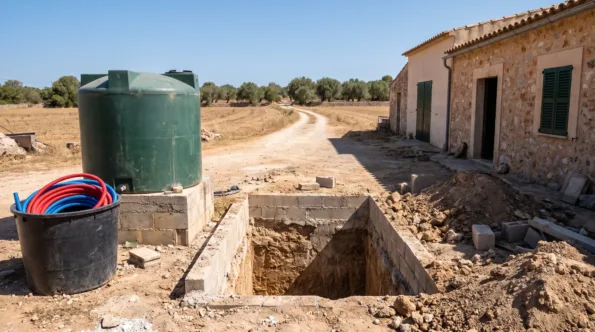
The parts that are not the building
On a town property the renovation is the building. On a finca a real share of the budget goes to things that are not the house at all: getting water, getting power, dealing with waste, and getting a lorry close enough to unload. Any one of them can outweigh a kitchen.
They are also the parts that are easiest to leave until the building work is priced, and the worst ones to discover late. A property some distance from a mains connection carries a cost that has nothing to do with its walls, and it is knowable early. It is worth asking for that figure separately, before the romantic part of the project starts.
The same applies to access. Deliveries and machinery down a narrow track set a pace that no amount of planning removes, and it shows up as time rather than as a line in the quote.
Where the work happens
Structural work
How your request reaches a company
Mallorca Renovation is a comparison service. A request for a finca restoration goes to the renovation and building companies on our list; they quote the work and carry it out, and any agreement is between you and the company you pick.
-
01
Describe the job
Tell us the property, roughly what you want and where it is. Photographs and a rough plan help, though neither is required.
-
02
We match it
The request goes to companies that work in your area and take on this kind of job at this size.
-
03
They quote you
Each company contacts you directly with its own price, timing and approach. We do not set any of it.
-
04
You compare and choose
Put the quotes side by side and take the one you want, or none of them. Using the site costs you nothing.
Can a finca be insulated without ruining the walls?
Usually, and the method matters more than the material. The principle is that the wall has to keep moving moisture, so anything that seals the inside face is the wrong answer whatever its performance figures say. Companies that work on older rural property will have a view, and it is worth asking for it in writing.
Are the outbuildings worth converting?
Often more than the house is. They tend to have simpler structure, fewer alterations already done to them, and no requirement to preserve a layout somebody lived in. Ask for them to be looked at as part of the survey rather than as an afterthought.
What does restoration cost compared with modernising?
They are different jobs rather than two prices for one, so the comparison only means something once the split is written down. Restoration spends on skilled labour; modernisation spends on new services and new fabric. The proportion is yours to choose and it is the single biggest lever on the total.
Should the original layout be kept?
It depends on how much of it survives and on how the building will be used. A ground floor built for animals rarely makes good living space without changes, and the upper floor often does. Deciding that early is what stops a restoration turning into a rebuild halfway through.