


Renovation in Costa d’en Blanes
Almost every plot here is a set of levels somebody built, and each level is held there by a wall doing real work. Before deciding anything about the house it is worth knowing what is holding the ground it sits on.
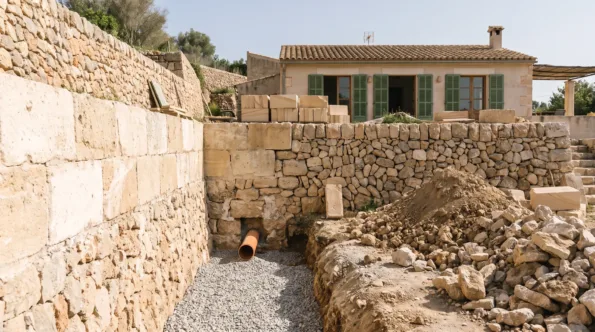
What holds the ground decides what the house can do
A retaining wall is a structure carrying a load that never stops pushing, and unlike a beam it is loaded from behind where nobody can see it. Whether it was built with drainage behind it, and whether that drainage still works, is the difference between a wall that stands for eighty years and one that leans slowly for ten and then does not.
This matters in a renovation because so much of what owners want here loads the ground further. A pool, a larger terrace, a parking level, an extension outward, even substantial planting all add weight or change where water goes. Any of them can turn an adequate retaining structure into an overloaded one, and that is a calculation rather than an opinion.
The signs are worth knowing. Cracks that step diagonally, a terrace that has moved away from the building, doors that used to close, damp appearing at the base of a wall in a new place. None of them proves a problem and all of them justify having somebody look before spending money on what is above.
What gets assessed before the house does
- The retaining walls, and whether drainage was built behind them
- Where water goes in heavy rain, and where it has started going instead
- Movement in terraces, steps and paving above a retained level
- Cracking that steps diagonally rather than running straight
- Anything added since that loads the ground more than the original design
- Pools, which are both weight and a potential source of water
- Tree roots and planting close to a retaining structure
- Access for machinery onto a level that is not the road level
- Foundations of the house itself relative to the levels around it
- What a new terrace or extension would add to all of the above
Most asked for on these plots
Nearby areas
How your request reaches a company
Mallorca Renovation is a comparison service. A request for work on a plot built in levels goes to the renovation and building companies on our list; they quote the work and carry it out, and any agreement is between you and the company you pick.
-
01
Describe the job
Tell us the property, roughly what you want and where it is. Photographs and a rough plan help, though neither is required.
-
02
We match it
The request goes to companies that work in your area and take on this kind of job at this size.
-
03
They quote you
Each company contacts you directly with its own price, timing and approach. We do not set any of it.
-
04
You compare and choose
Put the quotes side by side and take the one you want, or none of them. Using the site costs you nothing.
Is a leaning retaining wall urgent?
It depends whether it is still moving, which is measured over a period rather than judged in an afternoon. Monitoring is cheap and it answers the only question that matters before deciding how much to spend.
Can a pool go on an existing terrace?
Sometimes, and it is a ground question before it is a pool question. Water is heavy and a pool also introduces a possible leak above a retained level, so what is underneath is established first.
Why does drainage matter so much behind a wall?
Because water trapped behind a retaining structure pushes far harder than soil alone. Most retaining failures are drainage failures that took years to show, which is why it is the first thing anybody competent asks about.
Get quotes that start with the ground
Describe the plot and its levels once, and let several companies price the same scope.