

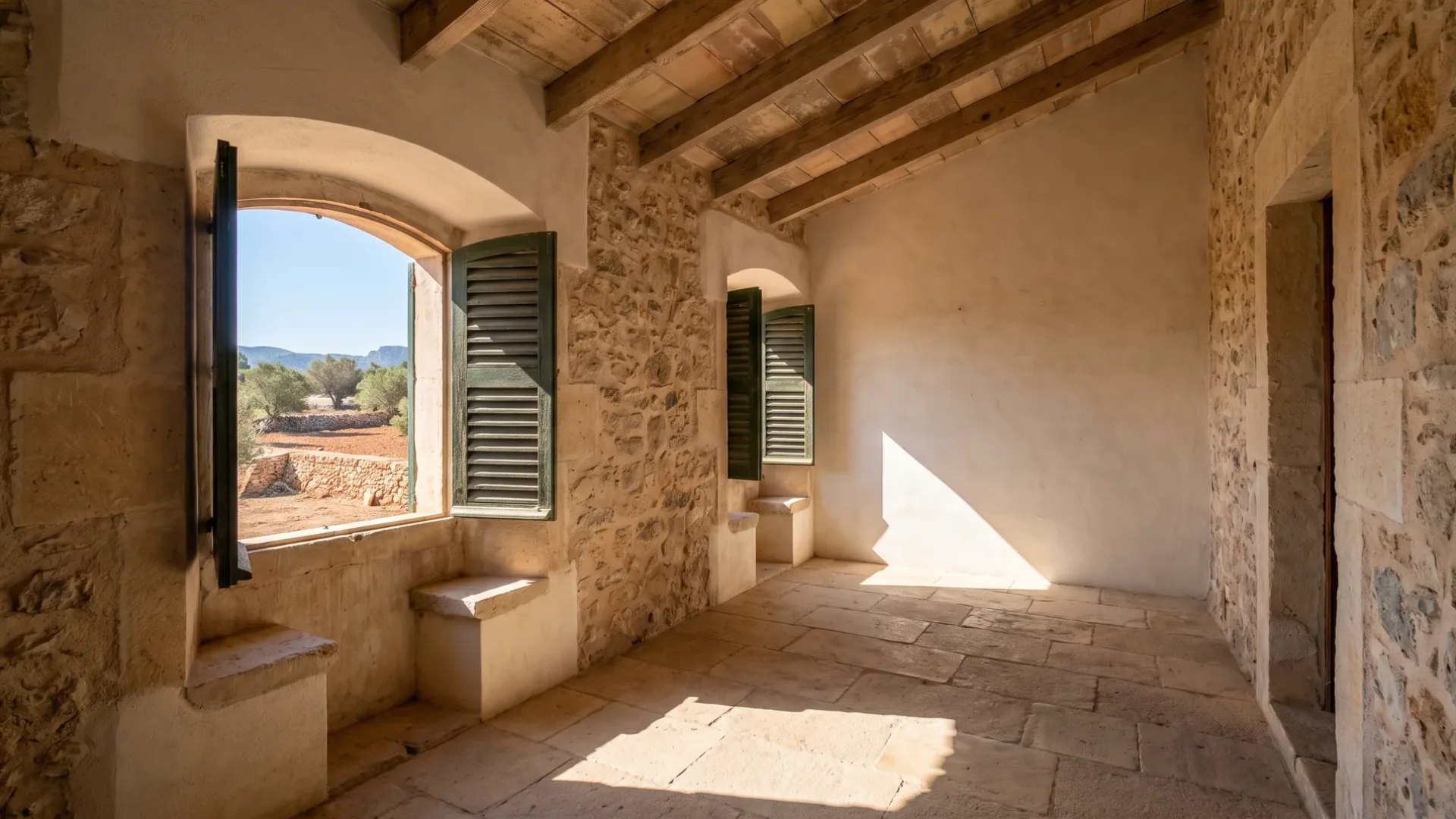
Renovation in Sineu
This is about as far from the coast as Mallorca goes, and without the sea nearby the temperature swings much further in both directions. The old buildings here answer that with mass, and it is worth understanding before deciding to change them.
Mass instead of machinery
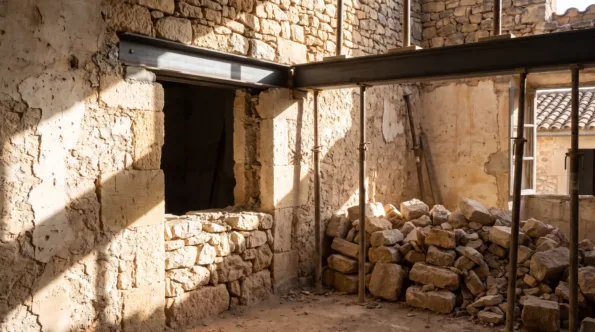
The sea keeps the coast within a narrower band of temperature all year. Inland there is nothing doing that, so summer days run hotter and winter nights run colder than they do twenty kilometres away. What the traditional buildings do about it is store the swing: very thick walls that absorb heat slowly, release it late, and keep the inside at something close to the average rather than the extreme.
It works, and it is easy to break. Cutting large openings into a thick wall removes the mass along with the wall, and a room that has been opened up generously to the south may be delightful in April and unusable in July. That is not an argument against opening up; it is an argument for pairing it with shading, glazing specification and orientation rather than treating it as a purely visual decision.
The same logic runs the other way in winter. Mass is slow, so a house of this kind takes a long time to warm and a long time to cool, which suits continuous gentle heating and suits intermittent blasts very badly. Owners who heat it like a modern house usually conclude it cannot be heated, when what it cannot do is respond quickly.
What a wide temperature swing changes
- Thick walls doing real work, which large openings remove
- Shading paired with any new opening rather than added later
- Glazing specified for solar gain, not only for the view
- Heating that runs gently and continuously rather than in bursts
- Slow response, which suits controls set to anticipate rather than react
- Insulation at the roof, where the losses and gains are largest
- Cross-ventilation to flush heat out overnight
- Materials that expand and contract across a wide range
- External shutters, which work before the heat gets in
- Rooms used differently in summer and winter, as they always were
Most asked for in the middle
How your request reaches a company
Mallorca Renovation is a comparison service. A request for a renovation inland goes to the renovation and building companies on our list; they quote the work and carry it out, and any agreement is between you and the company you pick.
-
01
Describe the job
Tell us the property, roughly what you want and where it is. Photographs and a rough plan help, though neither is required.
-
02
We match it
The request goes to companies that work in your area and take on this kind of job at this size.
-
03
They quote you
Each company contacts you directly with its own price, timing and approach. We do not set any of it.
-
04
You compare and choose
Put the quotes side by side and take the one you want, or none of them. Using the site costs you nothing.
Will opening up the walls make the house hot?
It can, and it is manageable if it is planned. The mass being removed was doing something, so what replaces it has to be shading, glazing specification or ventilation. The mistake is deciding the opening first and the consequences afterwards.
Why does the house take so long to warm up?
Because the walls have to warm up first, and they are enormous. A building of this kind wants steady gentle heat rather than short bursts, and controls that anticipate rather than react. It is a settings problem more often than a plant problem.
Is insulation worth it in a thick stone house?
At the roof, almost always, because that is where the largest losses and gains are. In the walls it is a more careful question, since the mass is already doing part of the job and whatever goes on has to let the wall breathe.
Get quotes for an inland property
Describe the house and how you use it through the year, and compare several prices.